During the Radical Reconstruction, there were new laws that were set up, like the Black Codes which was formed in 1865 and 1866 after the American Civil War. These laws were enacted to control the social boundaries between whites and former slaves that have been removed by the Emancipation Proclamation. These former slaves weren’t so much free due to still be treated horribly. They had very few legal rights like their testimony in court was inadmissible and any ligation that involved whites; they could not own property, and they couldn’t strike back if a white person attacked them. They couldn’t be away from their owner’s premised without permission, they couldn’t get together unless a white person was present, they weren’t allowed to own firearms, they couldn’t be taught to read or write, and they were not permitted to marry interracially. So Congress responded to the Black Codes by passing an act that extended the life of the Freedmen’s Bureau. In April of 1866, Congress passed the first Civil Rights Act that declared African Americans to be citizens of the United States and the federal government having the power to intervene with state affairs to protect the rights of the citizens. Johnson didn’t like the idea of the bills so he had vetoed them but Congress overrode both his vetoes.
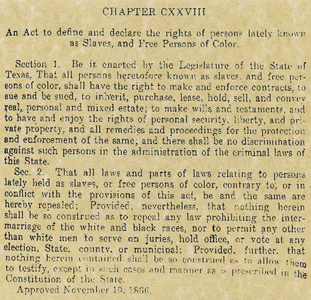
Thomas Woods and His Critics: A Review Essay. Web. 13 Dec 2010. http://www.la-articles.org.uk/BlackCode.gif.
Thomas Woods and His Critics: A Review Essay. Web. 13 Dec 2010. http://www.la-articles.org.uk/BlackCode.gif.
In April 1866, a new amendment was proposed to add on the Constitution by the Joint Committee on Reconstruction. The Fourteenth Amendment was approved by Congress, and it offered a definite definition of American citizenship. Everyone that was born in the United States and everyone naturalized, was automatically a citizen. Then the Fifteenth Amendment came about, which forbade the states and the federal government to deny suffrage to any citizen on account of race, color, or previous condition of servitude.
In 1867, congressional Radical passed to laws to stop the president from interfering with their plans. The first one was the Tenure of Office Act, which forbade the president to remove civil officials, or any members of his cabinet, without the consent of the Senate. The other law was the Command of the Army Act which prohibited the president from issuing military orders except thorough the commanding general of the army and not to assigned the army elsewhere without the permission of the Senate.

The Realignment Project. Web. 13 Dec 2010. http://realignmentproject.files.wordpress.com/2009/08/radicals.jpg?w=604&h=401.
The congressional Radicals too further action to stop the Supreme Court from interfering with their plans also. But in 1866, the case of Ex Parte Miligan stated that military tribunals were unconstitutional places where civil courts were functioning.

Johnson was still the administrator of reconstruction, so the congressional Radicals began looking for a way to impeach him. When Johnson had removed the Secretary of War, it violated the Tenure of Office Act, which sent a case to the Senate for trial. The trial had lasted April to May in the year of 1868. The Radicals had added heavy pressure towards the Republican senators; meanwhile the Moderates were losing faith of the Radical program. Seven Republicans joined the Democrats and independence to support acquittal. The vote was 35 to 19 causing the Radicals to drop the impeachment of Johnson.
Brinkley, Alan. American History: A Survey. 13th ed. 1. New York, NY: McGraw Hill, 2009. 410-413. Print.
Lynch, Hollis R. "Americans of African Ancestry." Web. 13 Dec. 2010. <http://history-world.org/black_codes.htm.>


No comments:
Post a Comment