Wednesday, December 15, 2010

Videos

KKK

Jim Crow laws and the Black Codes

Lincoln assassination

The Problems of Peacemaking

The aftermath of the war left the South completely destroyed. The South lost its slaves, property, money, and the war. It left them with almost no personal property and many faced starvation and homelessness. The South lost nearly 20% of its adult white male population that left many in mourning. Those that were left began to romanticize the war and its leaders. Robert E. Lee, Stonewall Jackson, and Jefferson Davis were treated as religious figures.

The Destruction of the South from the Civil War. Web. 15 Dec 2010. http://petercooper.info/LargePics/DestituteSouth.jpg.


Four million Southern slaves emerged from slavery after the war. Some served as servants, teamsters, and laborers for the Confederates. Others had fought as soldiers for the Union while others served as spies/scouts for the Union. Many took the opportunity to escape their captivity through the confusion that the war created. Although many stayed in the South and set up their own communities, churches, and schools instead of staying in white controlled communities. The federal government kept troops in the South after the war to provide protection and preserve order.


Civil War and Reconstruction. Web. 15 Dec 2010. http://faculty.umf.maine.edu/walter.sargent/public.www/web%20103/freedman1.jpg.

In March 1865, the Freedman’s Bureau was created as an army agency and was headed by General Howard. It helped to create schools, settle blacks on their own land, and they even helped some poorer whites. The main problem with its creation was that it was only allowed to operate for a year. Radical Republicans in Congress wanted the Confederate leaders to be punished. However, President Lincoln wanted to grant amnesty to white Southerners except to high-ranking officials of the Confederacy. The Southerners would then have to pledge loyalty to the government and accept that slavery was over. Once 10% of voters in 1860 took the oath, those voters could then set up a state government. He also wanted to give blacks the right to vote who were educated, owned property, and had served in the Union army. However Radical Republicans did not like President Lincolns plan. SO they passed the Wade-Davis Bill in July of 1864. It authorized the president to appoint a temporary governor to each Southern state. Once a majority of white males took the pledge, the governor could call up a state constitution convention to write a new constitution. Each constitution had to abolish slavery, disfranchise Confederate leaders, and repudiate Confederate debts. Afterwards, Congress would readmit those states to the Union. Lincoln died in April of 1865 so no one is for certain what would have happened with his plan. Andrew Johnson took office soon after his death. He offered amnesty to those Southerners who took the oath of allegiance. But the rest of his plan resembled the Wade-Davis Bill. To be readmitted, a state had to abolish slavery, revoke its secession ordinance, ratify the 13th Amendment, and repudiate all debts from the Confederacy.


Brinkley, Alan. American History: A Survey. 13th ed. 1. New York, NY: McGraw Hill, 2009. 406-410. Print.

The New South

The assassination of Abraham Lincoln in April 1865 brought Vice President Andrew Jackson into the White House. Republicans hoped that President Johnson would embrace their effort to reconstruct the defeated south. President Johnson still kept the same racial prejudices most republicans held. Johnson once told a journalist, "White men alone must manage the south". Johnson was against putting freed blacks in control of southern politics. Johnson hoped that middle class white southern unionists along with ex-confederates would take control of restoring the south to the union.

By April 1866, all of the states had fulfilled Johnson’s request of abolishing slavery and voiding all war debts that the states had incurred. Most states put up a fight but still followed the requests. The union victory in the civil war and the official end of slavery created great expectations for freed slaves. Some took new names which represented new identities and new beginnings. Others discarded the clothing provided by their masters and found new styles of dress. Also in 1866, congress passed two important bills designed to aid African Americans. The Civil Rights Act gave full citizenship to African Americans and overturned the 1857 Dred Scott decision. This bill defined all persons born in the United States as national citizens and included various rights such as the right to make and enforce contracts, to sue, to give evidence and to buy and sell property. Under this bill, African Americans "acquired full and equal benefit of all laws and proceedings for the security of person and property as it is enjoyed by white citizens." This gave southern African Americans a lot more freedom than they originally received. This bill did not totally change things but definitely took a step in the right direction.


Booker T. Washington believed in what he called the "Atlanta Compromise". This was basically the idea that all black citizens should adopt all the ways of the white middle class. He wanted African Americans to be "industrially educated". He believed that African Americans should focus on self-improvement in order to prepare themselves for equality. He believed that in order to advance as a race, they must improves as a race by white standards. Basically, this "compromise" was an unwritten promise that black people wouldn't challenge segregation.


Segregation was a big part of the new south. With the enactment of Jim Crow laws, African Americans were forced to use separate facilities from white people, such as bathrooms, drinking fountains, trains, buses, and restaurants. There were two cases that determined how our government felt about segregation in this time period. The first was Plessy v. Ferguson in 1896, where a black man named Homer Plessy in Louisiana didn’t want to ride in the train car that was designated for African Americans. The court ruled that “separate but equal” segregation was constitutional. The second case was Cumming v. County Board of Education in 1899, where the court ruled that separate schools for black and white children were constitutional even if schools for black children was not comparable to schools for white children. Rulings such as these allowed Jim Crow laws and segregation to continue up until the Civil Rights Act.

Brinkley, Alan. American History: A Survey. 13th ed. 1. New York, NY: McGraw Hill, 2009. 425-435. Print.

Monday, December 13, 2010

Radical Reconstruction

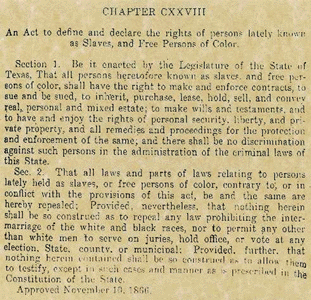
During the Radical Reconstruction, there were new laws that were set up, like the Black Codes which was formed in 1865 and 1866 after the American Civil War. These laws were enacted to control the social boundaries between whites and former slaves that have been removed by the Emancipation Proclamation.  These former slaves weren’t so much free due to still be treated horribly. They had very few legal rights like their testimony in court was inadmissible and any ligation that involved whites; they could not own property, and they couldn’t strike back if a white person attacked them. They couldn’t be away from their owner’s premised without permission, they couldn’t get together unless a white person was present, they weren’t allowed to own firearms, they couldn’t be taught to read or write, and they were not permitted to marry interracially. So Congress responded to the Black Codes by passing an act that extended the life of the Freedmen’s Bureau. In April of 1866, Congress passed the first Civil Rights Act that declared African Americans to be citizens of the United States and the federal government having the power to intervene with state affairs to protect the rights of the citizens. Johnson didn’t like the idea of the bills so he had vetoed them but Congress overrode both his vetoes.


Thomas Woods and His Critics: A Review Essay. Web. 13 Dec 2010.
http://www.la-articles.org.uk/BlackCode.gif.

 In April 1866, a new amendment was proposed to add on the Constitution by the Joint Committee on Reconstruction. The Fourteenth Amendment was approved by Congress, and it offered a definite definition of American citizenship. Everyone that was born in the United States and everyone naturalized, was automatically a citizen. Then the Fifteenth Amendment came about, which forbade the states and the federal government to deny suffrage to any citizen on account of race, color, or previous condition of servitude.

In 1867, congressional Radical passed to laws to stop the president from interfering with their plans. The first one was the Tenure of Office Act, which forbade the president to remove civil officials, or any members of his cabinet, without the consent of the Senate. The other law was the Command of the Army Act which prohibited the president from issuing military orders except thorough the commanding general of the army and not to assigned the army elsewhere without the permission of the Senate.
The congressional Radicals too further action to stop the Supreme Court from interfering with their plans also. But in 1866, the case of Ex Parte Miligan stated that military tribunals were unconstitutional places where civil courts were functioning.
Patell and Waterman’s History of New York. Web. 13 Dec 2010. http://ahistoryofnewyork.com/pictures/Andrew_Johnson-thumb-360x480.jpg.

Johnson was still the administrator of reconstruction, so the congressional Radicals began looking for a way to impeach him. When Johnson had removed the Secretary of War, it violated the Tenure of Office Act, which sent a case to the Senate for trial. The trial had lasted April to May in the year of 1868. The Radicals had added heavy pressure towards the Republican senators; meanwhile the Moderates were losing faith of the Radical program. Seven Republicans joined the Democrats and independence to support acquittal. The vote was 35 to 19 causing the Radicals to drop the impeachment of Johnson.

Brinkley, Alan. American History: A Survey. 13th ed. 1. New York, NY: McGraw Hill, 2009. 410-413. Print.

Lynch, Hollis R. "Americans of African Ancestry." Web. 13 Dec. 2010. <
http://history-world.org/black_codes.htm.>

The Ulysses S. Grant Administration

After the death of Lincoln, Andrew Johnson was elected president. Johnson favored abolition and believed that the leaders of the confederate south should be punished somehow, but he also believed that it should be made easy for the south to rejoin the union and have representatives in Washington. Congress however, tended to disagree. Johnson was a Democrat and congress at this time was controlled by the radical republicans. The radical republicans believed that the southern states should be dealt with very strictly. They believed in making freed slaves should be full citizens with full civil rights and they believed that the south should be ruled by military force until they met very strict standards for rejoining the union. Johnson and congress rarely agreed on anything. In 1867 Johnson suspended Edwin Stanton, secretary of war, and appointed Grant. Later in 1868 congress ordered Johnson to restore Stanton to his position which meant that Grant resigned. Johnson decided to threaten the unsupportive congress by forming his own army in Washington. This is when Grant withdrew his support of Andrew Johnson and began to support the radical republicans. In 1868 Grant won the election. (Riehecky, 43-45)

Grant was elected with much fanfare. He was considered to be the most popular general since Washington. To the American people he represented freedom and victory over tyranny and so he was very much loved as president. One thing that Grant did that angered some people, however, is that he chose cabinet leaders that were not necessarily experienced at the job that he gave them, and he did not announce his cabinet changes before he picked these people for the job. Being president this close to the end of the civil war presented a few problems. The first problem and the problem that Grant seemed to care about most was restoring the credit of the country. After the civil war, the value of the dollar dropped considerably and Grant realized how important it was to restore the dollar’s value. He signed his first bill on March 18, 1869. The bill was called the Act to Strengthen Public Credit. It basically helped to guarantee that people who had bought government bonds during the civil war would be paid back in gold or, at least, it’s equivalent. (Havilen 67-70)


Ulysses S. Grant
Grant's Whiskey Ring. Web. 13 Dec 2010. http://killerhistory.com/wp-content/uploads/2009/10/ulysses-s-grant1.jpg.

There was also a dispute between America and Britain that had to be settled. Three ships were built in British shipyards called the Alabama, Florida, and the Shenandoah. The Confederates had used these ships during the war to attack union vessels. Grant wanted Britain to pay for the damages and people thought that this could potentially lead to another war between Britain and the US. Grant realized that another war at this point would lead to the destruction of our country in this weak stage in our history. He sprung into action and ordered the Secretary of State Hamilton Fish to negotiate a settlement. The legislation worked and Britain agreed to pay the United States 15.5 million dollars. (Havilen, 71-72)

On September 24, 1869, two men named Jay Gould and Jim Fisk decided that they were going to take advantage of the weak state of the dollar and corner the gold market. They were going to buy enough gold that they could control the price of the precious metal. This was bad because when the price of gold rose, the value of the dollar would go down. The United States could not afford this at this point because the war had weakened the dollar’s value enough already. Gould and Fisk raised the price of gold from $135 an ounce to $165 an ounce. Treasury Secretary George Boutwell began selling the government’s shares of gold to drive the price of gold down and this was the first time in US history that the U.S. government stepped in to control the economy. (Havilin, 73)


George Boutwell
Financing the Civil War: The Office of Internal Revenue and the Use of Revenue Stamps. Web. 13 Dec 2010. http://acct.tamu.edu/giroux/image001.jpg.

It was during Grant’s administration that Congress passed the fifteenth amendment, giving black men the right to vote. He also made sure that the southern states would honor the amendment because he wanted the south to honor the laws of the United States and not just the state laws of the south. It was during his presidency that the Ku Klux Klan became a problem. In response, Grant signed the Ku Klux Klan Act in 1871 to give the US government the power to act out against the offenses of the Ku Klux Klan. Federal agents under Grant arrested over 500 clansmen. (Havelin, 73-74)

Brinkley, Alan. American History: A Survey. 13th ed. 1. New York, NY: McGraw Hill, 2009. 418-420. Print.

Havelin, Kate. Ulysses S. Grant. Minneapolis: Lerner Publications, 2004. Print.

Riehecky, Janet. Ulysses S. Grant: America's 18th President. New York: Children's, 2004. Print.

Sunday, December 12, 2010

The South in Reconstruction

“Scalawags" were mostly former members of the Whig party, wealthy men in search of economic development and success. Others were farmers that resided in rural areas, and were only interested in the Republicans because they believed their improvements to the area would help end their economic struggles.
“Carpetbaggers” referred to white men from the North who served as Republican leaders in the new South.  The term referred to a cheap suitcase, portraying an image of poverty. But in reality most of them were educated middle class citizens.
A threat to Carpetbaggers from the Klu Klux Klan
Tuscaloosa, Alabama, 1868
Klu Klux Klan. Web. 12 Dec 2010.
http://www.martinfrost.ws/htmlfiles/kkk_cart1.jpg.
African American freedmen would be the most numerous among Republicans in the South. They usually possessed no experience in politics, and intended to build institutions that would allow them to exercise their newly found power. They held conventions, called “colored conventions” by white southerners. Churches created by freedmen gave the African American communities a sense of unity and self-confidence in politics. They played a large role in reconstructing the South by serving as delegates in conventions, and holding public office. Between 1869 and 1901 there were twenty African Americans that served in the House of Representatives. There were also two Senators named Hiram Revels and Blanche K Bruce both of whom represented Mississippi. African Americans also held positions in state legislatures and other state offices.

Hiram Revels,
1st black U.S. senator, 1870
Flashback Lancaster. Web. 12 Dec 2010.
http://blogs.lancasteronline.com/flashbacklancaster/files/2008/11/revels.jpg.


To no surprise, white southerners complained of “Negro Rule” during Reconstruction. Ironically, no African Americans were governors in any of the southern states. The only time they came close to controlling state legislature was when they held the lower house majority in South Carolina for a brief period. In the south, the percentage of black people in office was much lower than the percentage of black people in the population.

The Reconstruction Era is denounced as a time of corruption and extravagancy by some. Many state officeholders got rich off of illicit activities, and state budgets expanded. State debts were significantly higher than ever before, in South Carolina the debt went from $7 million to $29 million in a period of just eight years. However the Northern states were said to be just as corrupt, and for the same reason: the growth of government services and revenue that tempted officials into corruption. The end of Reconstruction did little to end this, in many states corruption increased afterwards.

However the money that was spent during this era went to good things also, such as public education, public works programs, poor relief, and other commitments that the government had previously not been a part of.
In the South, groups called for improvements in public schools. Among these were the Freedman’s Bureau, Northern Philanthropic organizations, teachers at Freedmen's schools, and southern African Americans. White citizens feared education would give a “false notion of equality” to African Americans. Despite this, many schools were established. Four thousand schools were built by 1870, with nine-thousand teachers (half of whom were African American) and two-hundred thousand students (12% of the total school age population of African Americans.)

By 1876 40% of all African American children in the South were in school, and more than 50% of all white children. Black schools of higher education called “Academies” began to open. These eventually became universities and colleges, like Morehouse College and Fisk and Atlanta Universities.


There were early efforts to integrate Southern schools, which failed miserably. Schools such as the Freedmen’s Bureau Schools were open to all races but hardly any white children went to them. New Orleans set up integrated schools during the Reconstruction Era but similarly, white children did not attend. A federal effort to force school integration was the Civil Rights Act of 1875, but all the provisions for the desegregation of schools was removed before it was passed into law.

The Crises of Reconstruction. Web. 12 Dec 2010. http://websupport1.citytech.cuny.edu/Faculty/pcatapano/lectures_us2/schoolhouse.jpg.


Most land was not owned during the Reconstruction. Around 25% of African American farm laborers worked for wages. The rest were tenants of white landowners. They worked a plot of land that they owned in exchange for rent or a share of the crop. This way, African Americans had at least an independence from the landowners and got to work their own land, even if they would only ever rent the plot.

While African Americans earned money for working in post-slave society, they worked less. Adult men worked shorter days, and women and children were a lot less likely to labor outside. Their labor force worked 1/3 of the hours as they had before the war. This put this financially in the same category as white farmers. The income redistribution did little to help black citizens get out of poverty.

After the war, a new system emerged which was called credit. It was mostly used in rural stores, because the workers of the land near the stores depended on them for everyday necessities. Since the income of field workers isn’t as steady as other jobs, the stores would work out a deal in which the worker would pay later. Since the stores had virtually no competition they set ridiculous interest rates, as high as 60 percent. The workers would give the store a lien (claim) on their crop as collateral, which is why it was entitled the “crop-lien system”. If a worker were to suffer from a few bad crops in a row they would be trapped in debt for the rest of their lives.

This system had a number of negative effects on the south. Black citizens who had gotten land right after the war lost it as they fell into debt. A smaller amount of white landowners had the same happen to them. Southern farmers became totally dependent on cash crops (mostly cotton) because these crops seemed to be a way out of debt. They relentlessly planted cotton which exhausted the soil. The crop-lien system not only financially crippled farmers, but also hurt southern agriculture.


A sharecropper's cabin, North Carolina
Image Quiz. Web. 12 Dec 2010.
http://highered.mcgraw-hill.com/sites/dl/free/0073257184/89059/u26_11.jpg.
The most ambitious goal of Republican Radicals in Congress and the Freedmen’s Bureau was to reform landownership in the South. By 1865 the bureau had settled nearly 10,000 black families on abandoned plantations. But by the end of the year the plantation owners began to return and demand their property back, with the support of President Johnson. The government ended up returning most of the land to the original owners.


White landownership went from 80% before the war to 67% by the end of reconstruction. African Americans landownership went from around 0% to over 20%. It is said that most white citizens lost their land because of increased taxes or debts left unpaid, while some abandoned the land they owned for more fertile areas that they rented. There was an attempt by white citizens that were against slavery to encourage landownership among black citizens. It was called the Freedmen’s Bank, established 1865. They persuaded people to give their savings to the bank, but then invested in unsuccessful businesses. The bank failed in 1874.


Freedmen’s Savings and Trust Company. Web. 12 Dec 2010. http://www.blackpast.org/files/blackpast_images/Freedmens_Bank.jpg.
Many freed slaves rapidly disappeared from the plantations of the south after the war, mostly to find lost relatives. African Americans wandered throughout the south looking for their families. There were a few black newspapers at the time in which people posted advertisements looking for information about their missing relatives. They had their marriages sanctified by church and law. African Americans left the slave quarters and moved into cabins that were dispersed amongst the countryside. Male and female roles quickly morphed to that of white families; women and children ceased working outside in the fields. They believed this to be a “badge of slavery”. Women focused on domestic chores, and some husbands refused to let their wives work as servants to white people. However income forced many black women to work as servants or work in the fields. At the end of Reconstruction, half of all African American women over 16 were working. Unlike white women, most of them were married.

Brinkley, Alan. American History: A Survey. 13th ed. 1. New York, NY: McGraw Hill, 2009. 413-418. Print.

The Abandonment of Reconstruction

The Reconstruction of the South, was a very delicate era in America. The North became busy with their own political and economical issues, therefore putting reconstruction "on hold." The South's devastation potentially led to destruction. While some Southerners chose to keep their harsh opinions to themselves, others chose to put their thoughts into action, thus creating racial hate-groups. Though many different racist groups emerged during this time, the most infamously known African American hating group, the Ku Klux Klan, arose and was the most powerful. The Ku Klux Klan restricted the African Americans new found freedom. After enduring much oppression and terrible treatment, blacks were finally able to vote and earn citizenship. But many were still not able to enjoy those freedoms due to the KKK and other such groups. The hate groups were made up of so much ignorance that it was astounding. They would use physical force and torture to put fear into the African Americans discouraging them to even attempt to become politically active. The different groups would form alliances in a sense, and would make organizations impossible for African Americans to be involved in. Needless to say, blacks were still being excluded and felt as if they were inferior to the white folk.


Probert Encyclopaedia. Web. 12 Dec 2010. http://www.probertencyclopaedia.com/j/Ku%20Klux%20Klan.jpg.

Not every white citizen thought negatively towards the African Americans. Many actually sought to broaden their freedoms. Though some just seemed to be "big talkers," there were individuals who actually took action. The Republican Congress worked to overturn the fad of racist vigilantes. Enforcement acts were passed in 1870 and 1871 as an attempt to stop the hate crimes and to broaden the rights that the African Americans deserved without strings attached. The acts became more well known as the Ku Klux Klan acts. The acts restricted the states in many ways involving discrimination against race in voting, serving in juries, and holding public/ political offices. Even though these acts were beneficial to African Americans, there was also a downside to them.

Perhaps the biggest blow to African Americans during this time period was the Compromise of 1877. This Compromise was what in fact diminished the Reconstruction Era. It united the Democrats and Republicans, which ultimately made sure another Civil War would not erupt. This Compromise was never officially debated or documented, but it enabled the two opposing political parties to come to mutual agreements. However, it was a huge betrayal to the newly freed 4 million slaves. Though the Compromise was good for the Nation, it put Reconstruction and equality for the African Americans "on hold" yet again.

The Crises of Reconstruction. Web. 12 Dec 2010. http://websupport1.citytech.cuny.edu/Faculty/pcatapano/lectures_us2/reconstructionF06.html

Shortly after the Fifteenth Amendment was ratified, the Reconstruction period was almost completely halted. The North had the attitude of “they can take care of themselves now, there is nothing else we can do.” The blacks were at a loss of support, making it difficult for them to thrive. Just when the African Americans had thought that most of their economical problems were diminished, a new theory came along that put things in a new perspective. A new concept keyed as “Social Darwinism,” was a theory that was basically used to belittle and weaken minorities. The idea states that “an individual who fails did so because of their own weakness and unfitness.” Though it seems like it wouldn’t have any relation to the Abandonment of Reconstruction, it actually played a major role in it. It Social Darwinism caused the government to intervene in even more issues, which took away attention from the much needed Reconstruction Reform. The money and incentives that the freedmen were supposed to receive quickly vanished. The money and incentives were instead used for social services issues.

Brinkley, Alan. American History: A Survey. 13th ed. 1. New York, NY: McGraw Hill, 2009. 420-425. Print.


Corrick, James A. The Civil War and Emancipation. Farmington Hills: Lucent Books, 2008.

Debopriya, Bose. "Compromise of 1877." Buzzle (2010): n. pag. Web. 15 Dec 2010.
http://www.buzzle.com/articles/compromise-of%201877.html.

Mettger, Zak, Reconstruction: America After the Civil War. New York: Lodestar Books, 1994.